
The Nutriepigenomic Frontier in Retinal Health: Genetic Susceptibility, Epigenetic Regulation, and the Therapeutic Potential of Saffron Apocarotenoids in Age-Related Macular Degeneration
Age-Related Macular Degeneration (AMD) represents a multifaceted neurodegenerative challenge, serving as the primary cause of irreversible vision loss among aging populations in developed nations. By the year 2040, the global burden of this condition is projected to reach approximately 288 million individuals, necessitating a paradigm shift from reactive treatment to proactive, mechanism-based intervention.1 While the advent of anti-vascular endothelial growth factor (anti-VEGF) therapies has transformed the management of neovascular (wet) AMD, the atrophic (dry) form—comprising nearly 90% of all cases—remains a therapeutic vacuum, characterized by the progressive loss of retinal pigment epithelium (RPE) and photoreceptor cells.1 The pathogenesis of AMD is not a singular event but an intricate convergence of fixed genetic risk, environmental insults, and a dynamic epigenetic landscape that modulates cellular responses to aging.2 Recent investigations have moved beyond the traditional protein-coding paradigm to explore the regulatory "dark matter" of the genome, specifically non-coding RNAs (ncRNAs) and DNA methylation patterns that govern mitochondrial bioenergetics and cellular homeostasis.5 Within this complex milieu, the bioactive apocarotenoids of Saffron (Crocus sativus L.), primarily crocin and crocetin, have emerged as potent nutriepigenomic modulators. These compounds offer a novel therapeutic avenue by regulating the SIRT1–PGC-1 axis, inhibiting pathological DNA methylation, and stabilizing the ncRNA regulatory network, thereby fortifying the retina against the metabolic and oxidative rigors of senescence.8

The Genetic Landscape of Susceptibility
The genetic architecture of AMD is remarkably robust, with heritability estimates ranging from 46% to 71%, indicating that a significant portion of disease risk is determined by inherited variants.5 Genome-wide association studies (GWAS) have identified over 52 independent variants across 34 loci that contribute to the susceptibility of advanced AMD.10 These variants primarily cluster within pathways related to the complement system, lipid metabolism, extracellular matrix (ECM) maintenance, and angiogenesis.1

The Complement Cascade and Immune Dysregulation
The complement system, a critical component of the innate immune response, is the most prominent pathway implicated in AMD. The discovery of the CFH (Complement Factor H) Y402H polymorphism (rs1061170) marked a pivotal moment in AMD research, identifying a significant risk factor that impairs the regulation of the alternative complement pathway.1 CFH serves as a primary soluble inhibitor, and its functional reduction leads to unregulated inflammation and opsonization within the subretinal space.2 Further genetic associations have been confirmed in C2, C3, and CFB, reinforcing the concept of AMD as a disease of chronic, low-grade complement-mediated damage.1 Recent meta-analyses have also highlighted significant interactions between the CFI (Complement Factor I) locus and environmental factors such as smoking, which synergistically amplify the risk of disease progression.2

Lipid Metabolism and Transport
The retina is a lipid-rich environment, and the efficient transport and processing of these lipids are essential for maintaining the health of the RPE and the turnover of photoreceptor outer segments.1 Variations in genes such as APOE (Apolipoprotein E), LIPC, ABCA1, and ELOVL2 have been linked to the formation of drusen—the hallmark extracellular deposits of AMD.1 APOE variants, in particular, play a complex role in retinal cholesterol transport, while ABCA1 is involved in the efflux of cellular lipids, suggesting that defects in lipid handling contribute to the metabolic stress experienced by the RPE.1

Extracellular Matrix and Angiogenesis
The structural integrity of the Bruch’s membrane and the choriocapillaris is vital for retinal nutrient supply and waste removal.1 Polymorphisms in HTRA1 (High Temperature Requirement A1) and ARMS2 (Age-Related Maculopathy Susceptibility 2) are among the strongest genetic predictors of progression to advanced AMD, including both geographic atrophy (GA) and neovascularization.1 Furthermore, genes associated with angiogenesis, such as VEGFA and its receptor FLT1, are critical in the transition to wet AMD, where their overproduction triggers pathological vessel growth.11

Novel Loci and Diverse Ancestry
The International AMD Genomics Consortium (IAMDGC 2.0) has recently expanded our understanding of AMD genetics by incorporating data from diverse ancestries.10 This research identified novel risk loci, including OCA2 (melanosomal transmembrane protein) and NOA1 (nitric oxide associated 1), which play roles in melanosomal transport and nitric oxide signaling, respectively.2 Additionally, cytoplasmic tryptophanyl-tRNA synthetase 1 (WARS1) has been identified as a potential causal agent in both dry and wet AMD, likely mediated through plasma metabolites such as N-acetyltyrosine.11 These findings underscore the genetic heterogeneity of AMD and the importance of ancestry-specific risk assessment.10

|
Gene |
Pathway |
Biological Impact |
Association |
|
CFH |
Complement System |
Regulation of alternative pathway |
High-risk (Y402H) 1 |
|
HTRA1 |
ECM Maintenance |
Proteolysis of matrix proteins |
Progression to advanced AMD 1 |
|
ARMS2 |
Unknown/Mitochondria |
RPE mitochondrial stress |
Progression to advanced AMD 1 |
|
VEGFA |
Angiogenesis |
Neovascularization |
Wet AMD subtype 1 |
|
APOE |
Lipid Metabolism |
Cholesterol transport |
Drusen formation 1 |
|
TIMP3 |
ECM/Angiogenesis |
Metalloproteinase inhibition |
Geographic Atrophy vs. Wet AMD 1 |
|
C3 |
Complement System |
Central component of cascade |
Systemic inflammation 1 |
|
WARS1 |
Protein Synthesis |
Amino acid metabolism |
Causal risk factor 11 |
|
NOA1 |
Signaling |
Nitric oxide regulation |
Novel risk locus 2 |
The Epigenetic Landscape of the Aging Retina
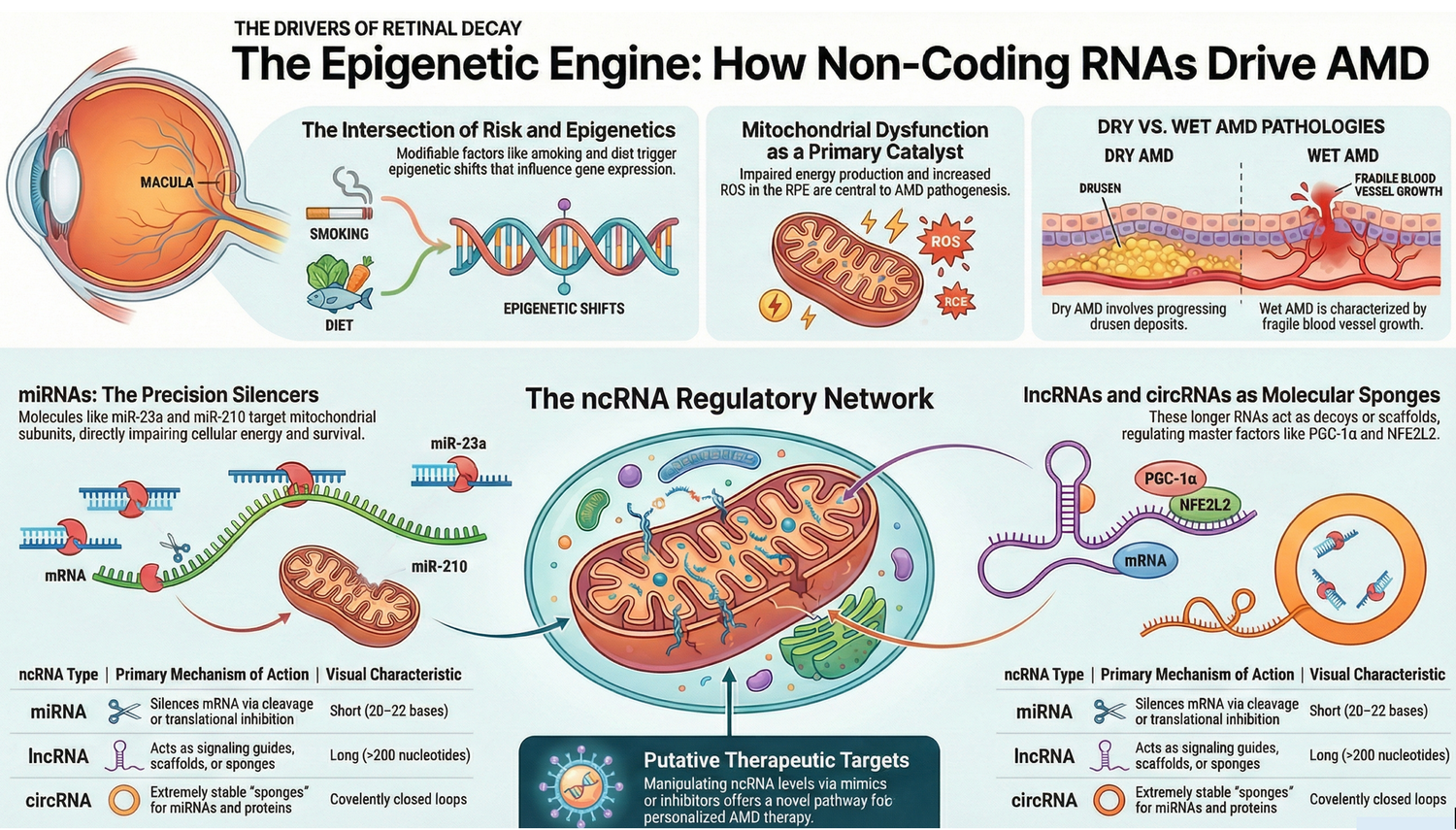
While genetic variants provide a template of risk, epigenetic mechanisms dictate the dynamic expression of these genes in response to aging and environmental stimuli.5 Epigenetics involves modifications such as DNA methylation, histone acetylation, and the regulatory actions of non-coding RNAs, which can alter gene activity without changing the underlying DNA sequence.5

DNA Methylation: The Environmental Sensor
DNA methylation typically occurs at CpG sites and is generally associated with gene silencing.15 In AMD, aberrant methylation patterns serve as a bridge between environmental risk factors and cellular dysfunction.5 For instance, smoking has been shown to cause hypomethylation of the GPR15 gene, leading to its upregulation and the induction of a chronic inflammatory response within the retina.1 Conversely, the promoter of the CLU (Clusterin) gene—an anti-inflammatory and anti-angiogenic factor—is often hypermethylated in the RPE of AMD patients, resulting in its repression and the loss of its neuroprotective capacity.5 Similarly, glutathione S-transferase genes (GST mu1 and mu5) undergo epigenetic silencing through hypermethylation, stripping the retina of essential antioxidant defenses.5

Histone Modification and Chromatin Plasticity
Histones act as the spools around which DNA is wound, and their modification by acetylation or methylation determines the accessibility of genes to transcriptional machinery.15 Histone acetyltransferases (HATs) promote an open chromatin state, while histone deacetylases (HDACs) generally lead to transcriptional repression.9 In the context of RPE pathologies, a "deficient" epigenetic landscape characterized by dysregulated HDAC activity has been implicated in the loss of cellular identity and the transition toward a pro-fibrotic phenotype.19 Treatment with HDAC inhibitors has been shown to modulate the expression of PEDF (Pigment Epithelium Derived Factor) and other protective proteins, highlighting the therapeutic potential of targeting chromatin remodeling.1

Non-Coding RNAs: The Regulatory Executive
Non-coding RNAs (ncRNAs) constitute a vast regulatory network that manages the majority of the human genome's output.1 These molecules are increasingly viewed as the primary executors of the epigenetic landscape in AMD.1
- MicroRNAs (miRNAs): These short molecules function by repressing mRNA translation.15 In AMD, miRNAs such as miR-181a/b and miR-23a are frequently upregulated, where they target and suppress genes essential for mitochondrial function and antioxidant response.1
- Long Non-Coding RNAs (lncRNAs): Molecules like TUG1 and MALAT1 serve as molecular scaffolds or sponges for miRNAs.1 TUG1, for example, enhances the Nrf2 antioxidant pathway by sponging inhibitory miRNAs, while MALAT1 has been linked to the Epithelial-Mesenchymal Transition (EMT) in stressed RPE cells.1
- Circular RNAs (circRNAs): These stable, covalently closed loops often act as decoys, soaking up harmful miRNAs and preventing them from reaching their targets.1
A critical epigenetic failure in dry AMD involves the loss of the DICER1 enzyme, which leads to the toxic accumulation of Alu transcripts.1 These ncRNA elements trigger the NLRP3 inflammasome, causing the RPE cell death that characterizes geographic atrophy.1

Mitochondrial Dysfunction and the PGC-1 alpha Master Regulator
The RPE is a tissue of high metabolic demand, responsible for the daily phagocytosis of photoreceptor outer segments and the maintenance of the blood-retinal barrier.1 This demanding workload is powered by a high density of mitochondria, whose health is governed by the master regulator PGC-1 alpha (Peroxisome proliferator-activated receptor gamma coactivator-1 alpha).1

PGC-1 alpha as the Metabolic Orchestrator
PGC-1 alpha stimulates mitochondrial biogenesis and enhances the efficiency of the electron transport chain.1 It coordinates with NRF2 (encoded by NFE2L2) to activate the antioxidant response, shielding the cell from Reactive Oxygen Species (ROS) generated during ATP production.1 In AMD, PGC-1 alpha is often repressed, leading to a catastrophic "energy crisis".1

Consequences of PGC-1 alpha Depletion
The loss of PGC-1 alpha activity results in several pathological hallmarks of dry AMD:
- Impaired Mitophagy: Damaged mitochondria are not efficiently cleared, leading to the accumulation of lipofuscin and the subsequent formation of drusen.1
- Oxidative Stress: The reduction in Nrf2-mediated antioxidant enzymes increases cellular vulnerability to photo-oxidative damage.1
- Metabolic Shift (EMT): RPE cells lose their specialized junctions and functions, gaining migratory properties that lead to subretinal fibrosis and geographic atrophy.1
Research using NRF-2/PGC-1 alpha double knockout (DKO) mice has demonstrated a phenotype that closely mirrors human dry AMD, including age-dependent RPE degeneration and mitochondrial fragmentation, validating this axis as a primary therapeutic target.29

|
Regulatory Element |
Function in Retina |
Regulation in AMD |
Pathological Outcome |
|
PGC-1 alpha |
Mitochondrial Biogenesis |
Repressed |
Energy crisis, RPE atrophy 1 |
|
NRF2 (NFE2L2) |
Antioxidant Defense |
Blunted |
ROS accumulation, DNA damage 1 |
|
SIRT1 |
PGC-1 alpha activation |
Downregulated |
Loss of metabolic flexibility 9 |
|
PINK1/PARKIN |
Mitochondrial Quality Control |
Inhibited by miRNAs |
Accumulation of toxic debris 1 |
|
SOD2 |
ROS Neutralization |
Decreased |
Mitochondrial DNA damage 13 |
Saffron (Crocus sativus) as a Nutriepigenomic Modulator
Saffron has evolved in pharmacological research from a traditional spice to a potent therapeutic agent with sophisticated neuroprotective properties.14 Its efficacy is derived from its unique apocarotenoids: crocin and crocetin.14

Clinical Evidence and Visual Function
Numerous clinical trials have established that daily oral saffron supplementation (typically 20 mg to 50 mg) provides significant functional benefits to patients with early-to-moderate AMD.1
- Visual Acuity: Long-term studies indicate that saffron improves best-corrected visual acuity (BCVA) and contrast sensitivity, with benefits stabilizing after three months and persisting as long as supplementation continues.1
- Retinal Sensitivity: Objective measures via focal electroretinography (fERG) and multifocal ERG (mfERG) show increased retinal flicker sensitivity and improved response density.1
- Safety Profile: Saffron is exceptionally well-tolerated, with toxic effects only observed at doses orders of magnitude higher than therapeutic levels (e.g., >5 g/day).1

Direct Regulation of Pathology-Related Genes
Transcriptomic analyses of the retina have revealed that saffron acts as a powerful gene regulator, normalizing the expression of elements that drive pathology.1
- Anti-Inflammatory Action: Saffron significantly reduces the expression of Ccl2 (chemokine ligand 2), thereby inhibiting macrophage recruitment and subretinal inflammation.1
- Stress Mitigation: It downregulates Hmox1 (heme oxygenase 1), normalizing it to control levels and indicating a reduction in chronic cellular stress.1
- Neurotrophic Support: Saffron upregulates Edn2 (endothelin 2), which is linked to the release of FGF-2, a factor essential for photoreceptor survival.1
Epigenetic Modulation: Inhibiting the "Erasers" and "Writers"
A major breakthrough in saffron research is the identification of its components as direct inhibitors of epigenetic enzymes.9
- DNMT1 Inhibition: In silico screening identifies beta-D-glucosyl trans-crocin as a potential inhibitor of DNA Methyltransferase 1 (DNMT1).9 By preventing hypermethylation, saffron may keep protective genes like CLU in an active state.5
- HDAC2 Inhibition: Crocetin has been shown to inhibit HDAC2, potentially reversing the chromatin compaction that silences antioxidant and anti-inflammatory genes in the aging retina.9
- SIRT1 Activation: Picrocrocin and crocetin activate SIRT1, the longevity-associated deacetylase that is required for the activation of PGC-1 alpha and Nrf2.8

Regulation of the ncRNA Network
Saffron’s most unique feature is its extensive regulation of non-coding RNAs.1 Microarray data indicates that saffron modulates a high proportion of ncRNAs to exert its neuroprotective effects.1
- miRNA Antagonism: Saffron may counteract the stress-induced upregulation of miR-23a and miR-27a, thereby restoring mitochondrial function and the autophagy-mitophagy pathway.1
- lncRNA Support: By potentially enhancing the expression of TUG1, saffron provides a molecular "shield" for PGC-1 alpha and Nrf2, ensuring the RPE remains resilient against oxidative injury.1

|
Target Class |
Specific Target |
Saffron's Action |
Consequence |
|
Epigenetic Enzyme |
DNMT1 |
Inhibition |
Prevents hypermethylation of protective genes 9 |
|
Epigenetic Enzyme |
HDAC2 |
Inhibition |
Promotes open chromatin for antioxidant genes 9 |
|
Transcription Hub |
SIRT1 |
Activation |
Restores PGC-1 alpha and Nrf2 pathways 8 |
|
Non-Coding RNA |
miR-23a |
Downregulation |
Restores MnSOD and mitochondrial health 1 |
|
Non-Coding RNA |
TUG1 |
Upregulation |
Enhances metabolic and antioxidant stability 1 |
|
Inflammatory Gene |
Ccl2 |
Reduction |
Decreases macrophage recruitment 1 |
|
Protective Gene |
Gpx3 |
Mitigation |
Restores extracellular antioxidant capacity 1 |

Saffron and Mitochondrial Health: The SIRT1–PGC-1 alpha Connection
The maintenance of RPE mitochondrial health is arguably the most critical factor in preventing AMD progression.1 Saffron apocarotenoids intervene in this pathway by targeting the SIRT1–PGC-1 alpha axis, a multi-target strategy shared with other interventions like exercise.8
Restoring Bioenergetics and Redox Balance
Saffron enhances retinal blood flow and oxygen diffusion, which naturally inhibits the production of VEGF and reduces the risk of neovascularization.3 Mechanistically, its activation of SIRT1 leads to the deacetylation and subsequent activation of PGC-1 alpha, which triggers:
- Mitochondrial Biogenesis: The creation of new, healthy mitochondria to replace those damaged by ROS.1
- Enhanced OXPHOS: Increased efficiency of oxidative phosphorylation and ATP production, addressing the energy crisis of the RPE.1
- Autophagy Restoration: Improved clearance of damaged proteins and organelles, preventing the formation of lipofuscin.1
Synergistic Effects with Lifestyle Interventions
Emerging research highlights a synergistic benefit when saffron supplementation is combined with physical activity.8 Both interventions target the SIRT1–PGC-1 pathway and Nrf2-mediated antioxidant defenses, amplifying the improvements in vascular remodeling and neurotrophic signaling.8 In animal models, the combination of saffron and endurance training has been shown to significantly increase PGC-1 alpha expression in neural tissues, suggesting a powerful multi-modal strategy for neuroprotection.8
Comparison with Emerging Epigenetic and Biological Therapies
The therapeutic potential of saffron is highlighted when compared to existing and emerging strategies for AMD, many of which target similar pathways but with different levels of specificity and safety.5
DNA Methylation Inhibitors (5-AZA)
5-azacytidine (5-AZA) and its derivative 5-aza-2′-deoxycytidine (DAC) are FDA-approved drugs for cancer that are being investigated for AMD.5 They work by inhibiting DNA methyltransferases to reactivate silenced genes.41
- Efficacy: In RPE cell cultures, 5-AZA has successfully upregulated CLU (Clusterin) and GST genes, restoring anti-inflammatory and antioxidant defenses.5
- Safety and Limitations: Unlike saffron, 5-AZA inhibitors lack gene specificity and can cause global epigenetic shifts.5 Furthermore, their systemic administration in a chronic disease like AMD poses significant toxicity risks.5

HDAC Inhibitors (Trichostatin A)
Trichostatin A (TSA) is an HDAC inhibitor that has demonstrated the ability to influence protein levels of VEGF-A, HIF1, and CFH in AMD-derived RPE cells.20 By maintaining a high level of histone acetylation, TSA can prevent the ischemic damage seen in neovascular AMD.1 However, the labile nature of these molecules and the requirement for precise preservation make them challenging for routine clinical use compared to the stable, orally available components of saffron.42
miRNA Mimics and Antagomirs
The use of synthetic "agomirs" to mimic protective miRNAs or "antagomirs" to inhibit pathological ones is an active area of research.1
- Mechanism: These therapies aim to restore youthful regulatory patterns in the retina.1
- Challenge: The delivery of these small RNAs to the posterior segment of the eye remains a significant hurdle, whereas saffron apocarotenoids naturally cross the blood-retinal barrier after oral ingestion.1
Photobiomodulation (PBM)
Photobiomodulation uses specific wavelengths of red or near-infrared light (e.g., 670 nm) to stimulate mitochondrial activity.1
- Convergence: PBM and saffron share many modulated gene pathways, including the regulation of FGF-2 and the mitigation of Ccl2.1
- Interference: Surprisingly, animal studies have shown no additive effect when PBM and saffron are administered simultaneously, suggesting they may compete for the same molecular pathways.43 Sequential administration, however, may offer a way to maximize neuroprotection.43
|
Therapy |
Target Mechanism |
Oral Bioavailability |
Safety Profile |
|
Saffron (Crocin) |
Nutriepigenomic, Multi-target |
High 8 |
Excellent 1 |
|
5-AZA / DAC |
DNA Methylation Inhibitor |
Low / Systemic |
Risk of global dysregulation 5 |
|
TSA / Vorinostat |
HDAC Inhibitor |
Variable |
High toxicity at systemic doses 17 |
|
Anti-VEGF |
Protein Neutralization |
None (Invasive) |
Risk of infection/scarring 1 |
|
PBM (670 nm) |
Mitochondrial stimulation |
N/A (Local) |
Non-invasive and safe 36 |
Conclusion and Future Directions
The integration of functional genomics and nutriepigenomics is rewriting our understanding of Age-Related Macular Degeneration. We are no longer limited to a deterministic view of genetic risk; instead, we recognize that the "software" of the eye—the epigenetic landscape—is a dynamic and reversible target for intervention.1 Saffron apocarotenoids, through their ability to modulate DNA methylation, inhibit HDACs, and regulate the ncRNA network, represent a sophisticated strategy for maintaining retinal homeostasis.1 By fortifying the SIRT1–PGC-1 alpha axis, saffron addresses the root metabolic failures that lead to RPE atrophy and geographic atrophy.1
Future research must focus on validating these molecular findings in human-derived RPE models, particularly exploring saffron's impact on high-value targets like DICER1 and the complement factor CFH.1 Furthermore, the development of precision delivery systems and the identification of serum miRNA signatures of treatment response will be essential for the transition to personalized eye care.1 As the therapeutic landscape for AMD expands, saffron—an ancient remedy validated by modern science—stands at the forefront of a new era of epigenetic medicine, offering a safe and effective means to protect the metabolic engine of sight.1


Key topics discussed:
• What is Age-related Macular Degeneration (AMD)?
• What causes macular degeneration at the cellular level?
• How does oxidative stress contribute to AMD progression?
• What role do epigenetics and DNA methylation play in retinal health?
• Can nutrition influence gene expression in AMD?
• What is nutriepigenomics and how does it relate to macular degeneration treatment research?
• How do mitochondrial dysfunction and inflammation interact in retinal disease?
• What emerging science is shaping future AMD management strategies?
Bibliography
Ahmadi, M., et al., 'Neuroprotective role of saffron in GEO database', Research Journal of Pharmacognosy, 11 no. 1 (2024). https://www.rjpharmacognosy.ir/article_211130_962f72520ef146b9e8129af5b672d97f.pdf
Bi, X., et al., 'Crocin exerts anti-proliferative and apoptotic effects on cutaneous squamous cell carcinoma via miR-320a/ATG2B', Bioengineered, 12 no. 1 (2021): 4569-4580. https://www.tandfonline.com/doi/full/10.1080/21655979.2021.1955175
Broadhead, G. K., et al., 'Saffron therapy for the treatment of mild/moderate age-related macular degeneration: a randomised clinical trial', Graefe's Archive for Clinical and Experimental Ophthalmology, 257 no. 1 (2019): 31-40. https://sydneyretina.com.au/resources/scientific-journal-publications/saffron-therapy-for-the-treatment-of-mild-moderate-age-related-macular-degeneration-a-randomised-clinical-trial/
Broadhead, G. K., et al., 'Saffron therapy for the ongoing treatment of age-related macular degeneration', BMJ Open Ophthalmology, 4 no. 1 (2019). https://pmc.ncbi.nlm.nih.gov/articles/PMC10941132/
Falsini, B., et al., 'Saffron Supplementation Improves Retinal Flicker Sensitivity in Early Age-Related Macular Degeneration', Investigative Ophthalmology & Visual Science, 51 no. 12 (2010): 6118–6124. https://pmc.ncbi.nlm.nih.gov/articles/PMC3407634/
Felszeghy, S., et al., 'Loss of NRF-2 and PGC-1$\alpha$ genes leads to retinal pigment epithelium damage resembling dry age-related macular degeneration', Redox Biology, 20 (2019): 1-12. https://pmc.ncbi.nlm.nih.gov/articles/PMC6156745/
Golestaneh, N., et al., 'Repressed SIRT1/PGC-1$\alpha$ pathway and mitochondrial disintegration in iPSC-derived RPE disease model of age-related macular degeneration', Journal of Translational Medicine, 14 (2016): 344. https://pmc.ncbi.nlm.nih.gov/articles/PMC5115823/
Heitmar, R., Brown, J., and Kyrou, I., 'Saffron (Crocus sativus L.) in Ocular Diseases: A Narrative Review of the Existing Evidence from Clinical Studies', Nutrients, 11 no. 3 (2019): 649. https://pmc.ncbi.nlm.nih.gov/articles/PMC11537240/
Hyttinen, J. M. T., et al., 'Non-Coding RNAs Regulating Mitochondrial Functions and the Oxidative Stress Response as Putative Targets against Age-Related Macular Degeneration (AMD)', International Journal of Molecular Sciences, 24 no. 1 (2023): 14. https://pmc.ncbi.nlm.nih.gov/articles/PMC11812471/
Karimi, P., et al., 'Crocetin Prevents RPE Cells from Oxidative Stress through Protection of Cellular Metabolic Function and Activation of ERK1/2', International Journal of Molecular Sciences, 21 no. 9 (2020): 3131. https://pmc.ncbi.nlm.nih.gov/articles/PMC7215651/
Maccarone, R., et al., 'Modulation of Type-1 and Type-2 Cannabinoid Receptors by Saffron', PLOS ONE, 11 no. 11 (2016). https://journals.plos.org/plosone/article?id=10.1371/journal.pone.0166827
Natoli, R., et al., 'Gene and noncoding RNA regulation underlying photoreceptor protection: microarray study of dietary antioxidant saffron and photobiomodulation in rat retina', Molecular Vision, 16 (2010): 1801-1822. https://pmc.ncbi.nlm.nih.gov/articles/PMC2932490/
Piccardi, M., et al., 'A Longitudinal follow-up study of saffron supplementation in early age-related macular degeneration', Evidence-Based Complementary and Alternative Medicine, (2012). https://pmc.ncbi.nlm.nih.gov/articles/PMC3850693/
Puddu, A., et al., 'Combination of Saffron (Crocus sativus), Elderberry (Sambucus nigra L.) and Melilotus officinalis Protects ARPE-19 Cells from Oxidative Stress', Antioxidants, 13 no. 1 (2024): 10. https://www.mdpi.com/2076-3921/14/12/1433
Reddy, P. S., et al., 'Crocetin: A systematic review of its distribution, production, and pharmacological activities', Frontiers in Pharmacology, 11 (2020). https://www.frontiersin.org/journals/pharmacology/articles/10.3389/fphar.2021.745683/full
Rivkaie, G., 'Mechanisms of Epigenetic Regulation: Roles of RNA and DNA Methylation', Journal of Molecular Pathology and Biochemistry, 5 (2024): 193. https://www.longdom.org/open-access/mechanisms-of-epigenetic-regulation-roles-of-rna-and-dna-methylation-1100098.html
Sanz-González, S. M., et al., 'miRNAs and Genes Involved in the Interplay between Ocular Hypertension and Primary Open-Angle Glaucoma', International Journal of Molecular Sciences, 22 (2021): 6112. https://pmc.ncbi.nlm.nih.gov/articles/PMC8196557/
Zhang, Y., et al., 'Diverse-Ancestry GWAS of Age-Related Macular Degeneration', Investigative Ophthalmology & Visual Science, 65 no. 4 (2024). https://pubmed.ncbi.nlm.nih.gov/41159651/
Works cited
- Saffron and the Epigenetic Landscape.docx
- Deciphering gene–smoking interactions in age-related macular ..., accessed February 13, 2026, https://pmc.ncbi.nlm.nih.gov/articles/PMC12306451/
- Crocus sativus (saffron) and age-related macular degeneration - Semantic Scholar, accessed February 13, 2026, https://pdfs.semanticscholar.org/1e77/523d2d99c007e9c31ba7619a36fc1e14d8ea.pdf
- A Longitudinal Follow-Up Study of Saffron Supplementation in Early Age-Related Macular Degeneration: Sustained Benefits to Central Retinal Function - PMC, accessed February 13, 2026, https://pmc.ncbi.nlm.nih.gov/articles/PMC3407634/
- An Updated Review of the Epigenetic Mechanism Underlying the ..., accessed February 13, 2026, https://www.aginganddisease.org/EN/10.14336/AD.2019.1126
- Functional genomics in age-related macular degeneration: From genetic associations to understanding disease mechanisms - PubMed, accessed February 13, 2026, https://pubmed.ncbi.nlm.nih.gov/40089136/
- Review of Non-coding RNAs and the epigenetic regulation of gene expression: A book edited by Kevin Morris - PMC, accessed February 13, 2026, https://pmc.ncbi.nlm.nih.gov/articles/PMC3398993/
- Integrative effects of saffron and physical activity on endurance ..., accessed February 13, 2026, https://pmc.ncbi.nlm.nih.gov/articles/PMC12695556/
- Epigenomics Nutritional Insights of Crocus sativus L.: Computational Analysis of Bioactive Molecules Targeting DNA Methyltransferases and Histone Deacetylases - PMC, accessed February 13, 2026, https://pmc.ncbi.nlm.nih.gov/articles/PMC12347544/
- Diverse-Ancestry GWAS of Age-Related Macular Degeneration on 16108 Examined Cases and 18038 Controls - PubMed, accessed February 13, 2026, https://pubmed.ncbi.nlm.nih.gov/41159651/?utm_source=Firefox&utm_medium=rss&utm_campaign=pubmed-2&utm_content=18WX1aNNAKMkvmZ3zRd8rf7ux6nkHIxCUrpyj8fRkD7UOkkAfZ&fc=20240423213508&ff=20251030001440&v=2.18.0.post22+67771e2
- Exploring Therapeutic Targets for Age-Related Macular Degeneration From Circulating Proteins to Plasma Metabolites in the European Population - PMC, accessed February 13, 2026, https://pmc.ncbi.nlm.nih.gov/articles/PMC12063708/
- Functional effect of Saffron supplementation and risk genotypes in early age-related macular degeneration: a preliminary report - PMC, accessed February 13, 2026, https://pmc.ncbi.nlm.nih.gov/articles/PMC3850693/
- (PDF) Repressed SIRT1/PGC-1α pathway and mitochondrial disintegration in iPSC-derived RPE disease model of age-related macular degeneration - ResearchGate, accessed February 13, 2026, https://www.researchgate.net/publication/311784484_Repressed_SIRT1PGC-1a_pathway_and_mitochondrial_disintegration_in_iPSC-derived_RPE_disease_model_of_age-related_macular_degeneration
- Crocus sativus (saffron) and age-related macular degeneration - PMC, accessed February 13, 2026, https://pmc.ncbi.nlm.nih.gov/articles/PMC11537240/
- Mechanisms of Epigenetic Regulation: Roles of RNA and DNA Methylation, accessed February 13, 2026, https://www.longdom.org/open-access/mechanisms-of-epigenetic-regulation-roles-of-rna-and-dna-methylation-1100098.html
- Saffron, Its Active Components, and Their Association with DNA and Histone Modification: A Narrative Review of Current Knowledge - PMC, accessed February 13, 2026, https://pmc.ncbi.nlm.nih.gov/articles/PMC9414768/
- Current trends in clinical trials and the development of small molecule epigenetic inhibitors as cancer therapeutics - PMC, accessed February 13, 2026, https://pmc.ncbi.nlm.nih.gov/articles/PMC11233149/
- Epigenomics Nutritional Insights of Crocus sativus L.: Computational Analysis of Bioactive Molecules Targeting DNA Methyltransferases and Histone Deacetylases - ResearchGate, accessed February 13, 2026, https://www.researchgate.net/publication/394377267_Epigenomics_Nutritional_Insights_of_Crocus_sativus_L_Computational_Analysis_of_Bioactive_Molecules_Targeting_DNA_Methyltransferases_and_Histone_Deacetylases
- Epigenetic Modifications in the Retinal Pigment Epithelium of the Eye During RPE-Related Regeneration or Retinal Diseases in Vertebrates - PubMed, accessed February 13, 2026, https://pubmed.ncbi.nlm.nih.gov/40722628/
- Age-related Macular Degeneration (AMD) mitochondria modulate epigenetic mechanisms in retinal pigment epithelial cells - eScholarship.org, accessed February 13, 2026, https://escholarship.org/content/qt03p1v0j8/qt03p1v0j8_noSplash_e9c6569c4fdad3532679e43e9c892e16.pdf?t=rsc80b
- Noncoding RNAs and DNA methylation as epigenetic modulators of breast cancer: mechanisms and clinical perspectives in the Iranian population, a systematic review - PMC, accessed February 13, 2026, https://pmc.ncbi.nlm.nih.gov/articles/PMC12837363/
- Serum miRNA modulations indicate changes in retinal morphology - Frontiers, accessed February 13, 2026, https://www.frontiersin.org/journals/molecular-neuroscience/articles/10.3389/fnmol.2023.1130249/full
- Epigenetic Regulation of DNA Methylation and RNA Interference in Gastric Cancer: A 2024 Update - MDPI, accessed February 13, 2026, https://www.mdpi.com/2227-9059/12/9/2001
- (PDF) Combination of Saffron (Crocus sativus), Elderberry (Sambucus nigra L.) and Melilotus officinalis Protects ARPE-19 Cells from Oxidative Stress - ResearchGate, accessed February 13, 2026, https://www.researchgate.net/publication/388903620_Combination_of_Saffron_Crocus_sativus_Elderberry_Sambucus_nigra_L_and_Melilotus_officinalis_Protects_ARPE-19_Cells_from_Oxidative_Stress
- Combination of Saffron (Crocus sativus), Elderberry (Sambucus nigra L.) and Melilotus officinalis Protects ARPE-19 Cells from Oxidative Stress - MDPI, accessed February 13, 2026, https://www.mdpi.com/1422-0067/26/4/1496
- Study insights in the role of PGC-1α in neurological diseases: mechanisms and therapeutic potential - Frontiers, accessed February 13, 2026, https://www.frontiersin.org/journals/aging-neuroscience/articles/10.3389/fnagi.2024.1454735/full
- Regulatory factors of Nrf2 in age-related macular degeneration pathogenesis - Semantic Scholar, accessed February 13, 2026, https://pdfs.semanticscholar.org/29a8/5df1a86987825f22da70568a508df49128e2.pdf
- HDGF Protects Retinal Pigment Epithelium from Glyoxal-Induced Ferroptosis via SIRT1/PGC-1α/Nrf2 Pathway - MDPI, accessed February 13, 2026, https://www.mdpi.com/2076-3921/14/12/1434
- The Nrf2 and PGC-1α deficient murine retina reveals retinal pigment epithelium damage that coincides with autophagy decline and damaged mitochondria. | IOVS, accessed February 13, 2026, https://iovs.arvojournals.org/article.aspx?articleid=2642230
- Loss of NRF-2 and PGC-1α genes leads to retinal pigment epithelium damage resembling dry age-related macular degeneration - PMC, accessed February 13, 2026, https://pmc.ncbi.nlm.nih.gov/articles/PMC6156745/
- Phytochemistry, Biological Activities, Molecular Mechanisms, and Toxicity of Saffron (Crocus sativus L.): A Comprehensive Overview - MDPI, accessed February 13, 2026, https://www.mdpi.com/2076-3921/14/12/1433
- Integrative Analyses of Metabolome and Transcriptome Reveals Apocarotenoid and Flavonoid Biosynthesis During Saffron ( Crocus sativus L.) Stigmas Development - PubMed Central, accessed February 13, 2026, https://pmc.ncbi.nlm.nih.gov/articles/PMC12317191/
- Crocetin: A Systematic Review - Frontiers, accessed February 13, 2026, https://www.frontiersin.org/journals/pharmacology/articles/10.3389/fphar.2021.745683/full
- Saffron therapy for the ongoing treatment of age-related macular degeneration - PMC - NIH, accessed February 13, 2026, https://pmc.ncbi.nlm.nih.gov/articles/PMC10941132/
- Saffron Therapy for Age-Related Macular Degeneration - Sydney Retina Clinic, accessed February 13, 2026, https://sydneyretina.com.au/resources/scientific-journal-publications/saffron-therapy-for-the-treatment-of-mild-moderate-age-related-macular-degeneration-a-randomised-clinical-trial/
- Gene and noncoding RNA regulation underlying photoreceptor ..., accessed February 13, 2026, https://pmc.ncbi.nlm.nih.gov/articles/PMC2932490/
- Modulation of Type-1 and Type-2 Cannabinoid Receptors by Saffron in a Rat Model of Retinal Neurodegeneration - PMC, accessed February 13, 2026, https://pmc.ncbi.nlm.nih.gov/articles/PMC5115823/
- Saffron and retina: Neuroprotection and pharmacokinetics | Visual Neuroscience | Cambridge Core, accessed February 13, 2026, https://www.cambridge.org/core/journals/visual-neuroscience/article/saffron-and-retina-neuroprotection-and-pharmacokinetics/25F1449D4975FD466DF4476C5C1FEE3B
- Effect of Endurance Training with Saffron Consumption on PGC1-α Gene Expression in Hippocampus Tissue of Rats with Alzheimer's Disease - Brieflands, accessed February 13, 2026, https://brieflands.com/journals/amhsr/articles/99131
- Crocetin Prevents RPE Cells from Oxidative Stress through Protection of Cellular Metabolic Function and Activation of ERK1/2 - PubMed Central, accessed February 13, 2026, https://pmc.ncbi.nlm.nih.gov/articles/PMC7215651/
- Novel Approaches to Epigenetic Therapies: From Drug Combinations to Epigenetic Editing - PMC, accessed February 13, 2026, https://pmc.ncbi.nlm.nih.gov/articles/PMC7911730/
- The future of epigenetics: Emerging technologies and clinical applications - CAS, accessed February 13, 2026, https://www.cas.org/resources/cas-insights/epigenetics-emerging-technologies
- Sequential PBM–Saffron Treatment in an Animal Model of Retinal Degeneration - MDPI, accessed February 13, 2026, https://www.mdpi.com/1648-9144/57/10/1059
- Serum miRNA modulations indicate changes in retinal morphology - ResearchGate, accessed February 13, 2026, https://www.researchgate.net/publication/366277316_Serum_miRNA_modulations_indicate_changes_in_retinal_morphology


Leave a comment
This site is protected by hCaptcha and the hCaptcha Privacy Policy and Terms of Service apply.