
Global Strategic Frameworks and National Eye Health Policies: A Comprehensive Analysis of Systemic Reform, Economic Burden, and the Management of Age-Related Macular Degeneration
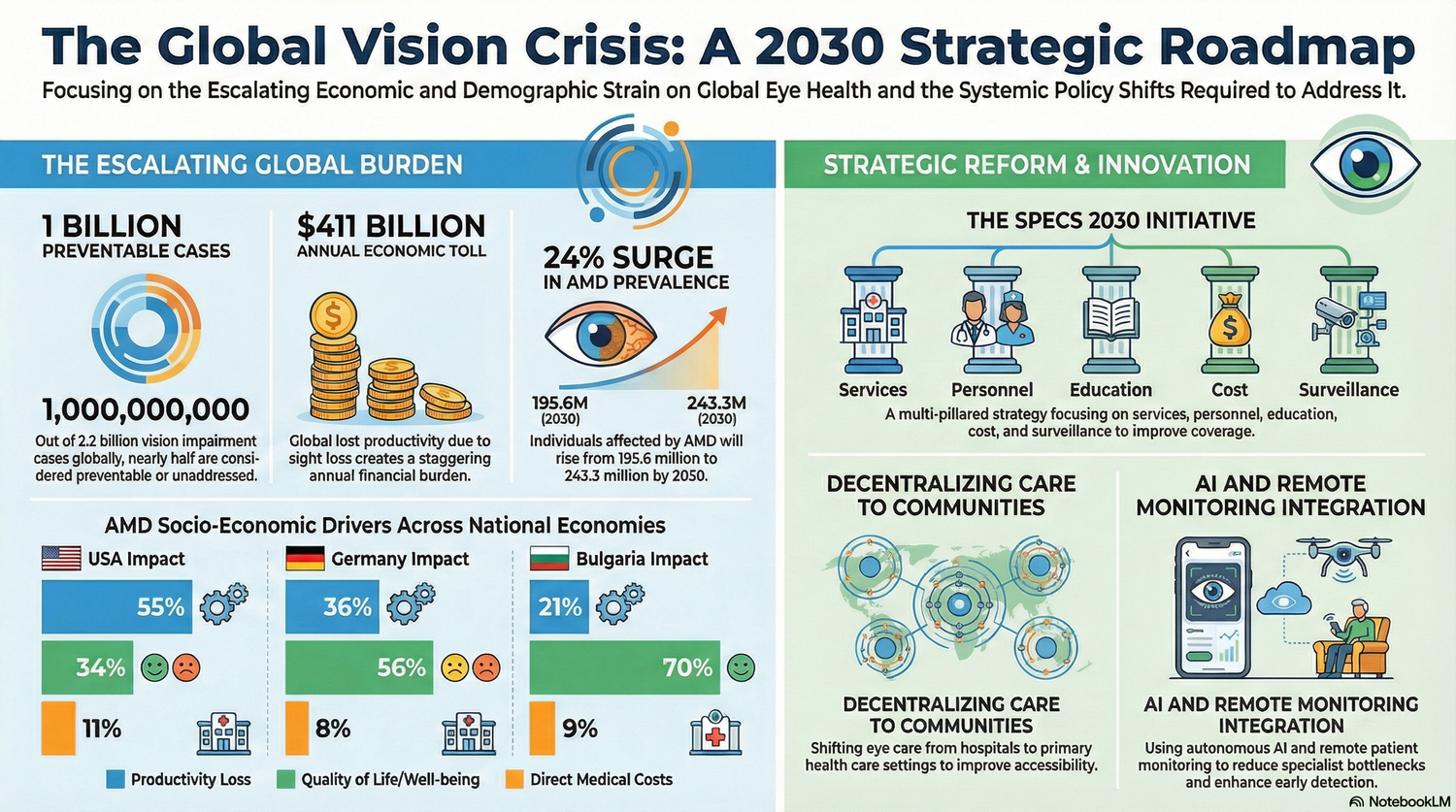
The global eye health landscape is currently navigating a period of profound transition, moving from a model defined by fragmented, disease-specific interventions toward a comprehensive paradigm of Integrated People-Centred Eye Care (IPCEC). This evolution is necessitated by a mounting global vision crisis, where at least $2.2$ billion people live with vision impairment, of which approximately $1$ billion cases are considered preventable or remain unaddressed. Central to this systemic strain is the demographic shift toward aging populations, which has precipitated an exponential increase in age-related eye conditions, most notably Age-Related Macular Degeneration (AMD). Projections indicate that the number of individuals affected by AMD will rise from $195.6$ million in 2020 to $243.3$ million by 2030, presenting an unprecedented challenge to the financial and clinical sustainability of national health systems. The economic repercussions are equally staggering, with sight loss estimated to cost the global economy $\$411$ billion annually in lost productivity. Consequently, national eye policies in high-income regions, including the European Union, Canada, and the United States, are being redesigned to prioritize early detection, streamline regulatory approvals for novel therapies, and integrate eye care into the broader framework of Universal Health Coverage (UHC).
The Global Policy Architecture: WHO Mandates and the 2030 Agenda
The foundational structure of modern eye health policy is rooted in the World Health Organization’s (WHO) World Report on Vision and the subsequent World Health Assembly resolution WHA73.4. These mandates urge Member States to integrate eye care as an essential component of UHC, recognizing that vision is not merely a clinical issue but a fundamental driver of socio-economic development. The policy framework is increasingly aligned with the United Nations 2030 Agenda for Sustainable Development, particularly Goal 3 (Ensure healthy lives and promote well-being) and Goal 1 (End poverty), as vision impairment disproportionately affects underserved populations and exacerbates economic hardship.
The SPECS 2030 Initiative and Effective Coverage Targets
To operationalize the high-level goals of IPCEC, the WHO has established specific global targets for 2030, focusing on a 40-percentage point increase in the effective coverage of refractive error (eREC) and a 30-percentage point increase in effective cataract surgical coverage (eCSC). These indicators serve as vital signs for the health system’s ability to deliver high-quality, equitable care. The SPECS 2030 initiative provides a multi-pillared strategy to achieve these goals, focusing on services, personnel, education, cost, and surveillance.
|
SPECS Pillar |
Strategic Objective |
Policy Mechanism |
|
Services |
Improve access to refractive services |
Integration into primary health care (PHC) and community settings |
|
Personnel |
Build workforce capacity |
Development of competency-based teams and task-shifting models |
|
Education |
Increase population awareness |
Public health campaigns to drive demand for early screening |
|
Cost |
Reduce financial barriers |
Scaling affordable technologies and reducing the cost of spectacles |
|
Surveillance |
Strengthen data and research |
Implementation of routine health information systems and research agendas |
The integration of these pillars into national health plans allows for a more resilient response to the projected surge in eye conditions. By embedding eye care within primary health care, systems can better adapt to changing demographics, ensuring that early identification of conditions like AMD occurs before irreversible sight loss transpires.
Economic Imperatives and the Societal Burden of Vision Loss
The economic burden of vision loss is a primary catalyst for national policy reform. Beyond the direct medical expenses, which often represent only a small fraction of the total cost, the societal impact includes lost productivity, caregiver burden, and reduced quality of life. In the United States, Germany, and Bulgaria, the total annual costs attributable to advanced AMD are estimated at $\$43$ billion, $\$7.6$ billion, and $\$449$ million, respectively.
Socio-Economic Cost Drivers of Advanced AMD
A nuanced analysis of these costs reveals that the primary drivers are often non-clinical. In the United States, loss of productivity accounts for approximately $55\%$ of the total burden, with up to $48\%$ of individuals with advanced AMD experiencing job loss. In contrast, in Germany and Bulgaria, reduced well-being—characterized by high rates of anxiety and depression—contributes significantly more to the total economic impact.
|
Economic Component |
USA Impact |
Germany Impact |
Bulgaria Impact |
|
Direct Medical Costs |
$11\%$ |
$8\%$ |
$9\%$ |
|
Productivity Loss |
$55\%$ |
$36\%$ |
$21\%$ |
|
Well-being/Quality of Life |
$34\%$ |
$56\%$ |
$70\%$ |
|
Annual Total Cost (Euros) |
$43$ Billion |
$7.6$ Billion |
$449$ Million |
These figures underscore the necessity of policies that go beyond acute clinical treatment to include vision rehabilitation and psychosocial support. The Retina International AMD Advocacy Taskforce has proposed a global policy framework that emphasizes standardized screening for those aged 50 and above, alongside the implementation of e-medical records and patient registries to better track longitudinal outcomes.
North American Policy Frontiers: The Canadian National Strategy
Canada has recently positioned itself as a global leader in eye health policy through the enactment of Bill C-284, the National Strategy for Eye Care Act. This legislation addresses the fragmented nature of Canadian eye care, which, while based on the principle of universal coverage, often leaves primary services like eye exams and spectacles as out-of-pocket expenses for the majority of the population.
Strategic Objectives of Bill C-284
The Act mandates the Minister of Health to consult with provincial governments, Indigenous groups, and healthcare stakeholders to develop a national framework within 18 months of its coming into force. The strategy is designed to achieve several critical objectives:
- Regulatory Acceleration: Ensuring that Health Canada can rapidly examine applications for drugs and devices related to eye disease, thereby shortening the time from laboratory discovery to clinical availability.
- Health Equity and Indigenous Consultation: Addressing the acute barriers faced by Indigenous and remote communities, including cultural mistrust and the high cost of travel for specialist care.
- Workforce Development: Identifying the training and guidance needs for healthcare professionals to enhance prevention and rehabilitation efforts.
- Awareness and Advocacy: The formal designation of February as "Age-Related Macular Degeneration Awareness Month" serves as a legislative mechanism to increase public education and demand for screening.
The Canadian approach recognizes that vision loss is a public health priority with a national economic burden of approximately $\$32.9$ billion. By creating a "vision desk" at the Public Health Agency of Canada, the government intends to set measurable goals to close gaps in health outcomes, particularly for underserved populations.
United States: Research Innovation and Reimbursement Paradigms
The United States maintains a dual focus on world-class research through the National Eye Institute (NEI) and complex reimbursement regulation through Medicare. The NEI Strategic Plan (2021-2025) outlines a vision for the future that prioritizes translational research and the application of emerging technologies to blinding diseases.
NEI Strategic Emphasis and "Bold Predictions"
The NEI plan is organized across seven cross-cutting "Areas of Emphasis" designed to link mechanistic science with clinical applications. For AMD, the plan emphasizes:
- Regenerative Medicine: Demonstrating the efficacy of the first induced pluripotent stem cell (iPSC)-derived products to replace or engineer retinal cells.
- Genetics and Biomarkers: Moving beyond identifying risk factors to developing AI-driven tools that identify new biomarkers for disease progression.
- Microbiome Research: Exploring how the gastrointestinal and ocular microbiomes interact with the immune system to influence diseased states in the retina.
- Public Education: Expanding the National Eye Health Education Program to encourage early detection of diabetic eye disease and glaucoma, while improving treatment for low vision.
Medicare and the 2025 Physician Fee Schedule
The clinical management of AMD in the U.S. is heavily influenced by Medicare reimbursement policies. Under Medicare Part B, diagnostic tests and injectable treatments for nAMD, such as anti-VEGF agents, are covered, with patients typically paying $20\%$ coinsurance. However, the CY 2025 Physician Fee Schedule (PFS) Final Rule introduced a $2.8\%$ decrease in the conversion factor (to $\$32.35$), which is estimated to result in an overall reduction of $-2\%$ for allowed charges in ophthalmology.
|
Medicare Component |
2024 Factor/Rule |
2025 Final Rule |
|
Conversion Factor |
$\$33.2975$ |
$\$32.35$ |
|
Ophthalmology Impact |
Variable |
$-2\%$ overall reduction |
|
Telehealth Rule |
PHE Flexibilities |
Audio-only allowed for home visits |
|
Performance Threshold |
75 Points |
Maintained at 75 points |
This fiscal tightening poses challenges for clinicians managing high-volume injection clinics. To mitigate these impacts, policies such as the Health Tech Investment Act (S. 1399) have been proposed to create a stable, five-year reimbursement pathway for FDA-authorized AI devices, potentially reducing the cost of screening and diagnosis.
European Union: Harmonization, HTA, and Digital Transformation
The European Union’s eye health strategy is characterized by efforts to reduce fragmentation across its Member States through the European Vision Institute (EVI) and societies like Euretina. The EU EYE has been integrated into the Health Technology Assessment (HTA) Stakeholder Network to ensure that new ophthalmic technologies are evaluated consistently across the continent.
ECOO Manifesto and the Shift to Community Care
The European Council of Optometry and Optics (ECOO) Manifesto for Eye Health and Vision 2024 emphasizes the importance of vision for healthy aging and independent living. A significant policy strand involves the integration of e-health and AI into primary care. Projects like I-SCREEN, which is EU-funded, aim to develop an AI-based infrastructure for the early detection and monitoring of AMD, empowering local professionals to offer reliable screening and reducing the burden on secondary care hospitals.
In the United Kingdom, the NHS 10-Year Health Plan specifically targets the shift of outpatient eye care from hospitals to community settings. Since ophthalmology is the busiest outpatient specialty in the NHS, delays in treating conditions like AMD and glaucoma are a major cause of irreversible sight loss. The policy focus is on:
- Enhanced Primary Care Pathways: Moving cataract and glaucoma referral refinement to high-street optometrists.
- Digital Default: Embracing digital triage and Advice and Guidance tools to empower patients and reduce unnecessary hospital visits.
France: National Strategic Reviews and Pediatric Focus
France’s 2025-2030 strategy, as outlined by the French National Authority for Health (HAS), prioritizes an integrated approach to care paths and the responsible use of digital technology. A notable French policy initiative is the "PlanVue" program, which targets children in priority education areas to screen for and treat myopia, recognizing that early-onset myopia is a precursor to severe eye conditions later in life.
Clinical Management and Prevention of AMD: Policy Implications
The prevention and management of AMD require a comprehensive approach that bridges public health initiatives with advanced clinical interventions. Policy must address modifiable risk factors while ensuring sustainable access to sight-saving treatments.
Prevention and Modifiable Risk Factors
Tobacco use remains the primary modifiable risk factor for advanced AMD. Comparative research from 204 countries indicates that robust tobacco regulation could reduce the future global burden of AMD-related vision impairment by millions of cases. Projections suggest that eliminating tobacco use could prevent $19.32$ million cases of AMD-related disability by 2050. Furthermore, the American Academy of Ophthalmology (AAO) Preferred Practice Patterns emphasize the role of a Mediterranean diet and specific antioxidant supplements (AREDS2) for those with intermediate AMD to slow progression to advanced stages.
Management of Neovascular AMD (nAMD)
The gold standard for nAMD management is intravitreal anti-VEGF therapy. However, the 2024 EURETINA Clinical Trends Survey reveals that the treatment burden remains a significant unmet need, with $63\%$ of practitioners citing the quantity of injections as a primary challenge for patients. Adherence is another critical factor; while older nAMD patients are generally consistent with treatment, missing visits for health emergencies can lead to poor long-term outcomes.
Innovation in Drug Delivery and Biosimilars
To address the injection burden, current research and policy are pivoting toward extended-duration treatments and dual-target inhibitors (e.g., VEGF/Ang-2). The introduction of biosimilars, such as ranibizumab-nuna and ranibizumab-eqrn, offers a mechanism to reduce the high cost of therapy, though many benefit plans now require step therapy protocols to prioritize these agents.
Australia: The National Strategic Action Plan for Macular Disease
Australia’s response to AMD is uniquely comprehensive, having developed a dedicated National Strategic Action Plan for Macular Disease. This plan focuses on four pillars: prevention/early detection, treatment, support, and data/research.
Progress and Ongoing Challenges
The Macular Disease Foundation Australia (MDFA) has reported significant success in raising community awareness, with over $200,000$ individuals completing the "Check My Macula" quiz to identify their individual risk. Key ongoing priorities include:
- Public Hospital Access: Improving the availability of clinics for those requiring regular sight-saving injections.
- Affordability and Persistence: Researching policy opportunities to help patients maintain long-term treatment schedules.
- Integrated Support: Scaling personalized support and practical advice through evidence-based health information programs.
Despite these advances, the prevalence of late AMD in non-indigenous Australians remains approximately $0.96\%$, increasing to $6.7\%$ in those aged 80 or older, highlighting the persistent need for sustained funding and policy focus.
Technological Implementation: AI screening and Remote Monitoring
The digital transformation of eye care is facilitated by new regulatory and reimbursement frameworks for AI and remote patient monitoring (RPM).
AI-Driven Retinal Screening
The global market for AI retinal screening is expected to reach $\$6.1$ billion by 2034, driven by the need for early detection in aging populations. Companies like Digital Diagnostics and Eyenuk are focusing on autonomous AI that reduces the specialized workforce required for initial screening. The I-SCREEN project in Europe exemplifies the policy shift toward empowering primary care practitioners with AI tools for AMD detection.
Remote Patient Monitoring (RPM) in 2025
Medicare's 2025 Physician Fee Schedule reinforces the role of RPM in chronic disease management. Clinicians can bill for the initial setup, device supply, and monthly management of patients monitored at home.
|
CPT Code |
Description |
Requirement |
2025 Est. Rate |
|
99453 |
Initial Setup |
One-time, education provided |
$\$20$ |
|
99454 |
Monthly Device/Data |
16 days of data in 30 days |
$\$47$ |
|
99457 |
First 20 min Management |
Real-time interactive comms |
$\$48$ |
|
99458 |
Additional 20 min |
Unlimited increments |
$\$39$ |
The "16-day rule"—requiring 16 days of data collection within a 30-day period—remains a strict requirement for billing. The expansion of these codes to Rural Health Clinics (RHCs) in 2025 is a significant policy victory for equitable access to advanced monitoring for rural populations.
Synthesis of National Policy Trajectories
The comparative analysis of eye health policies across Canada, the USA, the EU, and Australia reveals a unified strategic intent to shift the paradigm toward integrated, people-centred care. While the USA leads in clinical research and complex reimbursement innovation, Canada has established a legislative model for national coordination. The EU emphasizes cross-border harmonization and digital infrastructure, while Australia provides a condition-specific roadmap that addresses the unique challenges of AMD.
Common themes across these regions include:
- Integration into Primary Care: Recognizing that specialist-heavy models are unsustainable for managing the aging population's needs.
- Addressing the Economic Burden: Using policy to mitigate the massive productivity and well-being losses associated with advanced AMD.
- Technological Acceleration: Creating specific pathways for AI and remote monitoring to enhance early detection and reduce specialist bottlenecks.
- A Focus on Equity: Explicitly addressing the needs of Indigenous, rural, and lower-income populations who suffer disproportionately from vision loss.
As global demand for eye care continues to surge, the effectiveness of these national strategies will depend on their ability to translate these high-level frameworks into localized, accessible, and sustainably funded clinical services. The successful management of AMD, in particular, will require a lifelong approach to eye health that begins with pediatric prevention and extends through proactive, technology-enabled geriatric care.
Global Strategic Frameworks and National Eye Health Policies:
|
Country/Region |
Policy Framework or Legislation |
Strategic Objectives |
Annual Economic Cost |
Primary Socio-Economic Cost Driver |
Technology and Innovation Focus |
Primary Health Care Integration Status |
Source |
|
United States |
NEI Strategic Plan (2021-2025); Medicare Physician Fee Schedule (CY 2025); Health Tech Investment Act (S. 1399) |
Translational research linking mechanistic science with clinical applications; managing clinical reimbursement challenges. |
$43 Billion (Advanced AMD) |
Loss of productivity (55% of total burden) |
Regenerative medicine (iPSC), AI-driven biomarkers, microbiome research, and autonomous AI for screening. |
Expansion of remote patient monitoring codes to Rural Health Clinics (RHCs) in 2025. |
[1] |
|
Canada |
Bill C-284 (National Strategy for Eye Care Act) |
Regulatory acceleration for eye drugs/devices; health equity and Indigenous consultation; workforce development; public awareness campaigns. |
$32.9 Billion |
Not in source |
Rapid examination of applications for drugs and devices related to eye disease. |
Moving toward national coordination to close gaps in provincial universal coverage for primary services. |
[1] |
|
Germany |
Not in source |
Not in source |
$7.6 Billion (Advanced AMD) |
Reduced well-being (56% of impact) |
Not in source |
Not in source |
[1] |
|
Bulgaria |
Not in source |
Not in source |
$449 Million (Advanced AMD) |
Reduced well-being (70% of impact) |
Not in source |
Not in source |
[1] |
|
United Kingdom |
NHS 10-Year Health Plan |
Shifting outpatient eye care from hospitals to community settings to reduce treatment delays. |
Not in source |
Not in source |
Digital triage and "Advice and Guidance" tools to empower patients. |
Enhanced Primary Care Pathways moving cataract and glaucoma referral refinement to high-street optometrists. |
[1] |
|
Australia |
National Strategic Action Plan for Macular Disease |
Four pillars: prevention/early detection, treatment, support, and data/research. |
Not in source |
Not in source |
"Check My Macula" digital risk identification quiz. |
Scaling personalized support through evidence-based health information programs and community awareness. |
[1] |
|
European Union |
ECOO Manifesto for Eye Health and Vision 2024 |
Harmonization of technology evaluation (HTA) and digital transformation across Member States. |
Not in source |
Not in source |
I-SCREEN project (AI-based infrastructure for early detection of AMD). |
Empowering local primary care professionals with AI tools to reduce the burden on secondary care hospitals. |
[1] |


References:
cited
- Integrated people-centred eye care, including preventable vision impairment and blindness - World Health Organization (WHO), accessed January 29, 2026, https://apps.who.int/gb/ebwha/pdf_files/WHA73/A73_R4-en.pdf
- Integrated, people-centred eye care, including preventable blindness and impaired vision - World Health Organization (WHO), accessed January 29, 2026, https://apps.who.int/gb/ebwha/pdf_files/EB146/B146_13-en.pdf
- Global burden of vision impairment due to age-related macular degeneration, 1990–2021, with forecasts to 2050 - PubMed Central, accessed January 29, 2026, https://pmc.ncbi.nlm.nih.gov/articles/PMC12208786/
- 2030 In Sight: the future of global eye health - PMC - NIH, accessed January 29, 2026, https://pmc.ncbi.nlm.nih.gov/articles/PMC11269597/
- Integrating eye care in health systems - World Health Organization (WHO), accessed January 29, 2026, https://www.who.int/activities/integrating-eye-care-in-health-systems
- WHO SPECS 2030 – a global initiative to strengthen refractive error care - PMC - NIH, accessed January 29, 2026, https://pmc.ncbi.nlm.nih.gov/articles/PMC11141117/
- World Report On Vision - The International Agency for the Prevention of Blindness, accessed January 29, 2026, https://www.iapb.org/advocate/eye-health-and-universal-health-coverage/world-report-on-vision/
- Canada's Bill C-284 and the National Strategy for Eye Health Care - Operation Eyesight Universal, accessed January 29, 2026, https://www.operationeyesight.com/bill-c-284-canada-national-strategy-for-eye-health-care/
- World report on vision, accessed January 29, 2026, https://www.who.int/docs/default-source/documents/publications/world-vision-report-accessible.pdf
- retina-international.org, accessed January 29, 2026, https://retina-international.org/wp-content/uploads/2023/10/Recommendation-RI-Advocacy-Taskforce_20230623_NP-1.docx
- Bill C-284 (Historical) | openparliament.ca, accessed January 29, 2026, https://openparliament.ca/bills/44-1/C-284/?tab=stage-2
- Addressing vision care nationally | Optometry & Vision Science - University of Waterloo, accessed January 29, 2026, https://uwaterloo.ca/optometry-vision-science/news/addressing-vision-care-nationally
- Private Member's Bill C-284 (44-1) - Royal Assent - National Strategy for Eye Care Act - Parliament of Canada, accessed January 29, 2026, https://www.parl.ca/DocumentViewer/en/44-1/bill/C-284/royal-assent
- Canada Eyecare Report 2025 - Specsavers, accessed January 29, 2026, https://content.specsavers.com/canada/pdf/Canada+Eyecare+Report+2025_single.pdf
- National Strategy for Eye Care Act - Justice Laws Website, accessed January 29, 2026, https://laws-lois.justice.gc.ca/eng/AnnualStatutes/2024_28/page-1.html
- National Strategy for Eye Care Act - Justice Laws Website, accessed January 29, 2026, https://lois.justice.gc.ca/eng/acts/n-16.77/page-1.html
- National Strategy for Eye Care Act - Justice Laws Website, accessed January 29, 2026, https://laws-lois.justice.gc.ca/eng/acts/N-16.77/section-2.html?txthl=indigenous
- Written Submission to the Finance Committee for the 2026 Pre-Budget Consultations in Advance of the Upcoming Federal Budget The - Canadian Association of Optometrists, accessed January 29, 2026, https://opto.ca/sites/default/files/2025-08/CAO_2025_Pre-Budget-Submission_ENG.pdf
- National Eye Institute Releases National Plan for Eye and Vision Research, accessed January 29, 2026, https://www.nei.nih.gov/research-and-training/research-news/national-eye-institute-releases-national-plan-eye-and-vision-research
- NEI Strategic Plan Vision for the Future 2021-2025 - National Eye ..., accessed January 29, 2026, https://www.nei.nih.gov/sites/default/files/2021-10/NEI-StrategicPlan-ExecutiveSummary-508c.pdf
- Our Mission | National Eye Institute - NIH, accessed January 29, 2026, https://www.nei.nih.gov/about/our-mission
- Macular degeneration tests & treatment - Medicare, accessed January 29, 2026, https://www.medicare.gov/coverage/macular-degeneration-tests-treatment
- Does Medicare Cover Wet AMD Treatment? - Healthline, accessed January 29, 2026, https://www.healthline.com/health/medicare-coverage-wet-amd-treatments
- 2025 Medicare Physician Fee Schedule Final Rule Released - ASCRS, accessed January 29, 2026, https://www.ascrs.org/news/ascrs-news/2025-medicare-physician-fee-schedule-final-rule-released
- Medicare & AI: Health Tech Investment Act & Algorithm Reimbursement - Morgan Lewis, accessed January 29, 2026, https://www.morganlewis.com/pubs/2025/05/how-the-health-tech-investment-act-could-reshape-medicare-reimbursement-for-algorithm-based-services
- Medicare Reimbursement Pathway for AI-Enabled Medical Devices Considered in Senate's Health Tech Investment Act | Data Matters Privacy Blog, accessed January 29, 2026, https://datamatters.sidley.com/2025/05/14/medicare-reimbursement-pathway-for-ai-enabled-medical-devices-considered-in-senates-health-tech-investment-act/
- EVI – European Vision Institute | FEOph sight, accessed January 29, 2026, https://feoph-sight.eu/evi-european-vision-institute/
- European Vision Institute (EVI EEIG) | - EU EYE, accessed January 29, 2026, https://www.eueye.org/eueyemembers/european-vision-institute-evi-eeig/
- EU EYE, accessed January 29, 2026, https://www.eueye.org/
- Vision and eye health in policy making | ECOO, accessed January 29, 2026, https://ecoo.info/2024/04/vision-and-eye-health-in-policy-making/
- Primary eye care: Standing by to deliver the 10 Year Health Plan - College of Optometrists, accessed January 29, 2026, https://www.college-optometrists.org/news/2025/september/primary-eye-care-to-deliver-10-year-health-plan
- Bringing Eye Care Closer to Home: A New Partnership to Transform Ophthalmology Services, accessed January 29, 2026, https://primaryeyecare.co.uk/new-partnership-to-transform-ophthalmology-services/
- College response to the NHS England Medium Term Planning Framework, accessed January 29, 2026, https://www.college-optometrists.org/news/2025/october/response-nhs-england-planning-framework
- Medium Term Planning Framework – delivering change together 2026/27 to 2028/29 - NHS England, accessed January 29, 2026, https://www.england.nhs.uk/long-read/medium-term-planning-framework-delivering-change-together-2026-27-to-2028-29/
- Medium Term Planning Framework: what you need to know - NHS Confederation, accessed January 29, 2026, https://www.nhsconfed.org/publications/medium-term-planning-framework-what-you-need-know
- French National Authority for Health published its 2025-2030 strategy - MTRC, accessed January 29, 2026, https://mtrconsult.com/news/french-national-authority-health-published-its-2025-2030-strategy
- Santen EMEA Public Affairs Initiative: Raising Priority of Eye Health In Policy Agendas to Improve Patient Access to Treatment, accessed January 29, 2026, https://www.santen.com/en/stories/20251208
- Preventing visual impairments in schools in France - L'OCCITANE Foundation, accessed January 29, 2026, https://fondation.loccitane.com/actions/caring-for-sight/preventing-visual-impairments-in-schools-in-france
- Age-Related Macular Degeneration PPP 2024 - American Academy of Ophthalmology, accessed January 29, 2026, https://www.aao.org/education/preferred-practice-pattern/age-related-macular-degeneration-ppp
- Treatment Guidelines|Age-related Macular Degeneration|Clinical Guidance - Healio, accessed January 29, 2026, https://www.healio.com/clinical-guidance/age-related-macular-degeneration/treatment-guidelines-treatment-options-and-emerging-therapies
- Medical Drug Clinical Criteria, accessed January 29, 2026, https://files.providernews.anthem.com/6314/CC-0072_Pub-01-17-2025-(final).pdf
- EURETINA Clinical Trends Series Wet AMD & DME, accessed January 29, 2026, https://eplatform.euretina.org/wp-content/uploads/2025/08/EURETINA-Clinical-Trends-Series-Wet-AMD-DME.pdf
- Ophthalmologic Vascular Endothelial Growth Factor (VEGF) Inhibitors – Commercial Medical Benefit Drug Policy - UHC provider portal, accessed January 29, 2026, https://www.uhcprovider.com/content/dam/provider/docs/public/policies/comm-medical-drug/ophthalmologic-vegf-inhibitors.pdf
- National Strategic Action Plan for Macular Disease, accessed January 29, 2026, https://www.health.gov.au/resources/publications/national-strategic-action-plan-for-macular-disease?language=en
- A better view - National Strategic Action Plan for Macular Disease - Australian Government Department of Health, Disability and Ageing, accessed January 29, 2026, https://www.health.gov.au/sites/default/files/documents/2019/09/national-strategic-action-plan-for-macular-disease_1.pdf
- National Strategic Action Plan for Macular Disease -, accessed January 29, 2026, https://www.mdfoundation.com.au/news/national-strategic-action-plan-for-macular-disease/
- Prevalence of Age-Related Macular Degeneration in Australia: The Australian National Eye Health Survey - PMC - PubMed Central, accessed January 29, 2026, https://pmc.ncbi.nlm.nih.gov/articles/PMC5710385/
- AI-Driven Retinal Screening Device Market Size, 2034 - Global Market Insights, accessed January 29, 2026, https://www.gminsights.com/industry-analysis/ai-driven-retinal-screening-device-market
- A Guide to 2025 Remote Patient Monitoring CPT Codes & Reimbursement, accessed January 29, 2026, https://chroniccarestaffing.com/rpm/a-guide-to-2025-remote-patient-monitoring-cpt-codes-reimbursement/
- 2025 Remote Patient Monitoring CPT Codes: Quick Guide - OpenLoop Health, accessed January 29, 2026, https://openloophealth.com/blog/2025-remote-patient-monitoring-cpt-codes-quick-guide
- 2025 Billing Updates for Remote Monitoring of Patients - Smart Meter, accessed January 29, 2026, https://smartmeterrpm.com/wp-content/uploads/2025/01/2025-RPM-CPT-Summary-for-Providers-1.17.2025.pdf
- Remote Patient Monitoring: 2025 CPT Codes and Reimbursements - ThoroughCare, accessed January 29, 2026, https://www.thoroughcare.net/blog/remote-patient-monitoring-2025-cpt-codes-and-reimbursements

Leave a comment
This site is protected by hCaptcha and the hCaptcha Privacy Policy and Terms of Service apply.