
Abstract
The complement system is a central component of innate immunity that bridges pathogen recognition, inflammation, and clearance of cellular debris. Dysregulation of complement activation has emerged as a major driver of age-related macular degeneration (AMD), particularly at the level of the retinal pigment epithelium (RPE), Bruch’s membrane, and choriocapillaris.(1–3) Genome-wide association studies have identified strong AMD risk variants in complement factor H (CFH), complement component 3 (C3), complement factor B (CFB), complement factor I (CFI), and other complement genes, providing compelling genetic evidence that abnormal regulation of the alternative pathway contributes to disease susceptibility and progression.(1,3–5) Complement components and activation fragments are enriched in drusen and subretinal deposits, and elevated systemic complement activation products have been reported in patients with AMD.(1,2,6)
Mechanistically, chronic low-grade complement activation at the RPE–Bruch’s membrane–choriocapillaris interface promotes inflammation, recruitment of microglia and macrophages, endothelial damage, and formation of the membrane attack complex (MAC), contributing to RPE degeneration, choroidal vascular rarefaction, and photoreceptor loss.(1,2,7) Age-related changes in Bruch’s membrane, oxidative stress, lipid accumulation, and advanced glycation end products further amplify complement activation and impair local regulation by CFH and other inhibitors.(1,2,8) Complement dysregulation is implicated in both non-neovascular (dry) AMD, including geographic atrophy, and neovascular (wet) AMD, where complement-derived anaphylatoxins may enhance angiogenic signalling.(1,7,9)
Therapeutic strategies targeting the complement pathway—particularly complement C3 and C5 inhibitors—have shown efficacy in slowing lesion growth in geographic atrophy, culminating in regulatory approvals of intravitreal agents such as pegcetacoplan and avacincaptad pegol.(10–13) However, most complement-directed trials for neovascular AMD have yielded limited additional benefit over anti–vascular endothelial growth factor (VEGF) therapy, underscoring the complexity of complement’s roles in retinal homeostasis and angiogenesis.(10,11,14) This review explains complement biology with emphasis on the classical, lectin, and alternative pathways; summarizes genetic and molecular evidence linking complement to AMD; and outlines current and emerging complement-targeted therapies and their clinical implications.
Introduction
Age-related macular degeneration is a leading cause of irreversible central vision loss in older adults and a major public health challenge in ageing populations.(1,3) The disease encompasses a spectrum from early and intermediate AMD, characterized by drusen and pigmentary changes, to advanced forms manifesting as geographic atrophy or choroidal neovascularization.(1,3) While anti-VEGF therapy has transformed outcomes in neovascular AMD, therapeutic options for non-neovascular AMD have historically been limited, prompting intense interest in disease-modifying strategies.
The complement system has been implicated in AMD pathogenesis by converging lines of evidence. Complement proteins and activation fragments are abundant in drusen and Bruch’s membrane; complement genes carry some of the strongest genetic risk signals for AMD; and systemic markers of complement activation are elevated in affected individuals.(1–3,5,6) These findings have positioned complement dysregulation as a central, though not exclusive, mechanism driving chronic inflammation and tissue damage in the outer retina.
This article provides a mechanistic overview of complement activation pathways, describes how the complement system is regulated in the eye, and explains how genetic and environmental factors converge to disturb this regulation in AMD. It then reviews the clinical landscape of complement inhibitors and highlights emerging directions such as gene therapy and personalized complement modulation.
Complement System Basics
Overview of Complement Pathways
The complement system comprises more than 30 soluble and membrane-bound proteins that coordinate opsonization, chemoattraction, cell lysis, and immune complex clearance.(1,2) Complement activation occurs through three primary pathways—classical, lectin, and alternative—that converge at the level of C3 cleavage and C5 activation, leading to formation of MAC (C5b–9).(1,2,7)
- Classical pathway: Triggered by binding of C1q to antigen–antibody complexes or certain pathogen surfaces, leading to activation of C1r/C1s and sequential cleavage of C4 and C2 to form the C4b2a C3 convertase.(1,2)
- Lectin pathway: Initiated by mannose-binding lectin (MBL), ficolins, or collectins recognizing pathogen-associated carbohydrate patterns, which activate MBL-associated serine proteases and generate the same C4b2a C3 convertase as the classical pathway.(1,2)
- Alternative pathway: Characterized by continuous low-level “tick-over” of C3 to C3(H2O), which can bind factor B and be cleaved by factor D to form the C3bBb C3 convertase.(1,2,7) This pathway can be amplified on activating surfaces lacking adequate complement regulators.
All three pathways converge on C3 cleavage to C3a and C3b. C3b participates in opsonization and formation of C5 convertases (C4b2a3b or C3bBb3b), which cleave C5 into C5a, a potent anaphylatoxin, and C5b, the initiator of MAC formation. MAC inserts into cell membranes, causing lysis or sublytic activation depending on context.(1,2,7)
Complement Regulation
Tight regulation of complement is essential to prevent bystander damage to host tissues.(2,7,11) Soluble and membrane-bound regulators—including factor H (FH), factor I (FI), C4b-binding protein, decay-accelerating factor (CD55), membrane cofactor protein (CD46), and CD59—control convertase formation and MAC assembly.(1,2,7)
FH is the major regulator of the alternative pathway, acting as a cofactor for FI-mediated degradation of C3b and accelerating decay of C3 convertases.(1,2,7) FH binds to polyanionic surfaces and sulfated glycosaminoglycans, enabling discrimination between host and pathogen surfaces. Local concentration and binding affinity of FH are critical determinants of complement activation at tissue interfaces such as Bruch’s membrane.(1,2,8)
Complement Biology in the Eye
Local Complement Production
Although complement proteins circulate systemically, many are also produced locally in ocular tissues, including the RPE, choroid, Müller cells, and microglia.(1,3,7) This local synthesis allows fine-tuned regulation of complement activity at the outer retina–choroid interface but also provides a source for chronic activation when regulatory mechanisms fail.
Immunohistochemical studies show deposition of C3, C5, CFH, and MAC components in drusen, Bruch’s membrane, choriocapillaris, and areas of geographic atrophy, indicating persistent complement activation in AMD eyes.(1,2,6,7) RPE cells express complement receptors and can respond to complement activation fragments with pro-inflammatory cytokine release, further amplifying local inflammation.(2,7)
Age-Related Changes in Bruch’s Membrane and RPE
Bruch’s membrane thickens and accumulates lipids and advanced glycation end products (AGEs) with age.(1,2,8) These changes reduce hydraulic conductivity, impair waste removal, and alter the extracellular matrix landscape. Importantly, age-related loss of heparan sulfate proteoglycans (HSPGs) diminishes binding sites for FH and other regulators, reducing complement inhibition at this interface.(1,8)
Accumulation of oxidized lipids, lipoproteins, and AGEs in Bruch’s membrane and RPE can act as neoantigens, triggering complement activation via the classical and alternative pathways.(1,2,8) Drusen—extracellular deposits rich in lipids, complement components, and immune mediators—serve both as reservoirs and amplifiers of complement activity.(1,2,6) Together, these age-related structural and biochemical changes create a microenvironment prone to chronic complement activation and insufficient regulation.
Genetic Evidence Linking Complement to AMD
Complement Factor H and Related Genes
The landmark discovery of a single nucleotide polymorphism (Y402H) in CFH as a strong risk factor for AMD provided the first compelling genetic evidence linking complement to the disease.(3–5) The CFH Y402H variant is associated with decreased binding of FH to HSPGs and C‑reactive protein on host surfaces, reducing its ability to regulate alternative pathway activation at Bruch’s membrane and RPE.(3,4,8) Individuals homozygous for the risk allele have substantially increased risk of both neovascular AMD and geographic atrophy.(3–5)
Additional variants in CFH and related genes—including CFHR1–CFHR5—modulate AMD risk, highlighting the importance of the FH protein family in complement regulation at the ocular surface.(1,3–5,15) Structural rearrangements leading to hybrid CFH–CFHR genes or altered CFHR protein levels may further disturb complement control.(3,5,15)
Complement Component 3 and Alternative Pathway Genes
Genome-wide association studies have identified AMD risk alleles in C3, the central complement component, and in genes encoding factor B (CFB) and factor I (CFI).(3–5,9,15) C3 variants such as R102G confer increased risk, possibly through altered binding to regulators or enhanced activation.(3,4,9) Certain CFB alleles are protective, consistent with reduced formation of the alternative pathway C3 convertase.(3,4,15) Rare loss-of-function mutations in CFI, which normally cleaves C3b and C4b, also increase AMD susceptibility by impairing complement downregulation.(3,4,15)
Collectively, these genetic data point to a model in which heightened alternative pathway activation and/or impaired regulation promotes chronic complement-mediated damage in susceptible individuals.
Systemic Complement Activation Markers
Elevated plasma or serum levels of complement activation fragments—such as C3a, C5a, Ba, and soluble MAC (sC5b‑9)—have been reported in AMD patients compared with controls, with some correlations to disease stage and progression risk.(2,6,9,16) These findings suggest that AMD may be associated with both local ocular and systemic complement dysregulation. However, heterogeneity between studies and overlapping comorbidities indicate that systemic markers alone are unlikely to fully capture individual risk.(2,9,16)
How Complement Contributes to AMD Pathophysiology
Chronic Inflammation and Microglial Activation
Complement activation products such as C3a and C5a are potent chemoattractants and activators of microglia and macrophages.(1,2,7) In AMD, microglia accumulate in the subretinal space and around drusen and areas of atrophy, where they can release pro-inflammatory cytokines, proteases, and ROS.(1,2,7,17) Sustained complement-driven microglial activation may contribute to RPE and photoreceptor damage and promote transition from early to advanced AMD.
Membrane Attack Complex and Choriocapillaris Loss
MAC (C5b–9) is found in increased amounts in choriocapillaris endothelial cells beneath drusen and in areas of geographic atrophy.(1,2,7,18) Sublytic MAC deposition can induce endothelial activation, while high levels can cause cell lysis, leading to choriocapillaris dropout. Loss of choriocapillaris reduces oxygen and nutrient supply to the RPE and outer retina, potentially accelerating atrophic changes.(7,18)
Intersection with Oxidative Stress and Lipid Dysregulation
Oxidative stress and lipid accumulation interact bidirectionally with complement activation. Oxidized lipoproteins and AGEs can activate complement, while complement-mediated inflammation generates additional ROS and promotes lipid oxidation.(1,2,8,19) This feed-forward loop may be particularly relevant at the macula, where high metabolic demand, dense photoreceptor packing, and exposure to light increase oxidative burden.
Roles in Neovascular AMD
Complement involvement is not limited to dry AMD. C3a and C5a can upregulate VEGF expression in RPE and choroidal endothelial cells, promoting angiogenesis.(1,7,9) Complement activation in the choroid may therefore contribute to the development and maintenance of choroidal neovascular membranes. However, clinical trials combining complement inhibitors with anti-VEGF agents have not consistently shown additive benefit, suggesting that complement is one of several interacting drivers of neovascularization.(10,11,14,20)
Clinical Research and Treatment Landscape
Complement Inhibitors for Geographic Atrophy
As noted in the geographic atrophy article, intravitreal complement inhibitors constitute the first class of approved therapies that slow lesion growth.
C3 inhibition – Pegcetacoplan
Pegcetacoplan is a pegylated peptide that binds C3 and C3b, inhibiting all complement pathways upstream of C3 activation.(10,11) In the phase 3 OAKS and DERBY trials, monthly and every-other-month pegcetacoplan injections reduced geographic atrophy lesion growth by approximately 16–22% relative to sham over 24 months, with a dose-dependent effect.(10,11) Conversion to neovascular AMD occurred more frequently in treated eyes, highlighting a trade-off between reduced atrophy progression and elevated exudative risk.(10,11)
C5 inhibition – Avacincaptad pegol
Avacincaptad pegol is an RNA aptamer that selectively binds C5 and prevents its cleavage to C5a and C5b.(12,13,21) The GATHER1 and GATHER2 trials showed that monthly avacincaptad pegol reduced geographic atrophy growth by roughly 14–18% at 12 months compared with sham.(12,13,21) As with pegcetacoplan, treated eyes exhibited higher rates of neovascular conversion. Long-term data are being collected to clarify durability of benefit, functional outcomes, and safety.(13,21)
Both agents are now approved in several jurisdictions for geographic atrophy secondary to AMD, offering clinicians the first disease-modifying option for this condition.(10–13,21)
Complement Modulation in Neovascular AMD
Several trials have evaluated complement inhibitors as adjuncts to anti-VEGF therapy in neovascular AMD, including agents targeting factor D (lampalizumab), C5 (eculizumab, avacincaptad pegol), and C3.(11,14,22,23) To date, these studies have not demonstrated consistent improvements in visual acuity or reduction in anti-VEGF injection burden compared with anti-VEGF monotherapy.(11,14,22,23) Reasons may include differences in disease stage, redundancy in angiogenic pathways, and potential protective roles of complement in vascular homeostasis.
Other Complement-Targeted Agents
A variety of complement modulators are in earlier stages of development, including:
- Factor D inhibitors (for example, lampalizumab) designed to selectively suppress the alternative pathway amplification loop; phase 3 trials in geographic atrophy were negative for efficacy.(22)
- CFH replacement or potentiation therapies, including recombinant FH or CFH-derived peptides intended to restore regulation at Bruch’s membrane.(11,24)
- Gene therapies delivering complement regulators (such as CFH) via viral vectors to the RPE or choroid, seeking sustained local modulation with a single administration.(11,24)
- Oral complement inhibitors targeting systemic complement activation, though ocular-specific benefits and safety remain to be established.(11,24)
Emerging Research Directions
Precision Complement Modulation
Given heterogeneity in genetic background and complement activity among AMD patients, precision approaches that tailor complement modulation to individual risk profiles are being explored.(3,4,11,15) For example, patients with high-risk CFH or C3 variants or elevated systemic complement activation might derive differential benefit from specific inhibitors. Integrating genetic testing, plasma biomarkers, and ocular imaging could refine patient selection and trial design.
Combinatorial Strategies
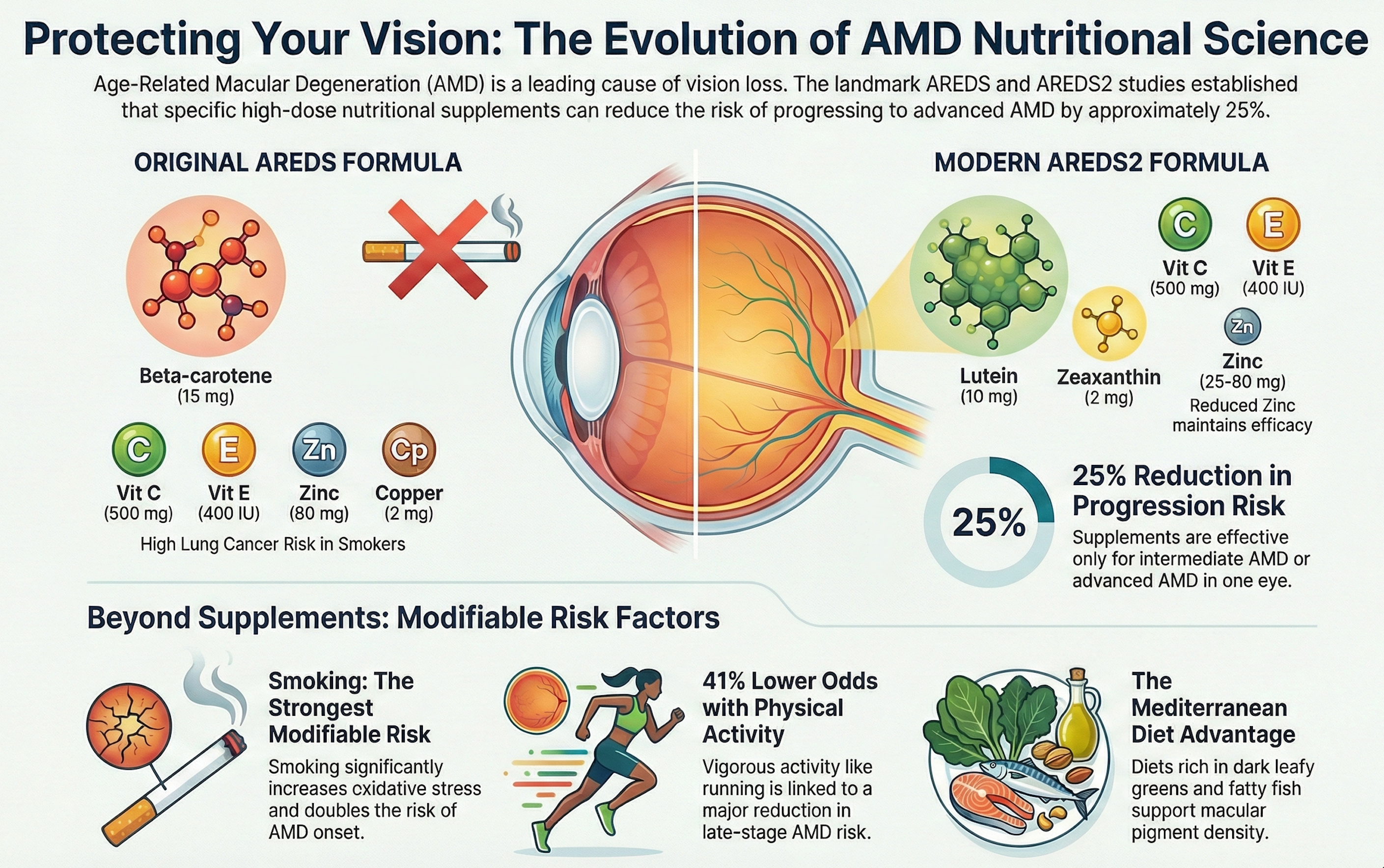
Complement dysregulation interacts with oxidative stress, lipid metabolism, microglial activation, and ferroptosis.(1,2,5,8,14,19) Combined strategies that modulate complement alongside antioxidant, anti-inflammatory, or cell-death-targeted therapies may achieve greater neuroprotection than any single pathway approach. Studies integrating complement inhibitors with AREDS-based supplementation, mitochondrial support, or ferroptosis modulators are conceptually attractive but remain largely preclinical.
Timing of Intervention
An important question is when in the disease course complement inhibition is most effective. Current approvals target eyes with established geographic atrophy, where substantial structural damage has already occurred.(10–13) Ongoing trials are investigating complement inhibition in earlier AMD stages to determine whether progression to geographic atrophy or neovascular AMD can be delayed.(11,24) Balancing potential long-term benefits against treatment burden and safety will be critical in earlier intervention strategies.
Understanding Protective Roles of Complement
While excessive complement activation is pathogenic, basal complement activity contributes to host defence and clearance of debris.(1,2,7,11) Complete or chronic blockade of complement carries theoretical risks of infection and impaired tissue homeostasis. Future research aims to develop modulators that fine-tune rather than abolish complement activity, potentially via pathway-selective or context-dependent inhibition.
Conclusion
The complement system has moved from a peripheral consideration to a central pillar of current understanding of age-related macular degeneration. Genetic, histological, biochemical, and clinical evidence converge on a model in which dysregulated alternative pathway activation at the RPE–Bruch’s membrane–choriocapillaris interface drives chronic inflammation, choriocapillaris loss, and RPE/photoreceptor degeneration.(1–5,7–9,18) Complement also interacts with oxidative stress, lipid dysregulation, and angiogenic signalling, contributing to both non-neovascular and neovascular AMD phenotypes.(1,2,7,9,19,20)
The advent of intravitreal C3 and C5 inhibitors that slow geographic atrophy growth represents a major therapeutic milestone, confirming complement as a druggable pathway in AMD.(10–13,21) At the same time, increased risk of neovascular conversion and the modest magnitude of structural benefit highlight the need for careful patient selection, vigilant monitoring, and continued refinement of treatment strategies.(10–13,21,22) Future work focusing on precision complement modulation, combination therapies, and earlier-stage intervention—while preserving essential complement functions—may yield more substantial preservation of visual function over the lifespan of patients with AMD.
This article is for educational purposes only and reflects current scientific literature at the time of writing.
References
- Clark SJ, Bishop PN, Day AJ. The complement system in age-related macular degeneration. Adv Exp Med Biol. 2014;801:195–221. https://pmc.ncbi.nlm.nih.gov/articles/PMC8195907/[pmc.ncbi.nlm.nih]
- Whitmore SS, Sohn EH, Chirco KR, et al. Complement activation and choriocapillaris loss in early AMD: a mechanistic review. Prog Retin Eye Res. 2015;45:1–29. https://pmc.ncbi.nlm.nih.gov/articles/PMC6650090/[pmc.ncbi.nlm.nih]
- Fritsche LG, Igl W, Bailey JNC, et al. A large genome-wide association study of age-related macular degeneration highlights contributions of rare and common variants. Nat Genet. 2016;48(2):134–143. https://pmc.ncbi.nlm.nih.gov/articles/PMC8195907/[pmc.ncbi.nlm.nih]
- Klein RJ, Zeiss C, Chew EY, et al. Complement factor H polymorphism in age-related macular degeneration. Science. 2005;308(5720):385–389. https://pubmed.ncbi.nlm.nih.gov/15761122[mayoclinic.elsevierpure]
- Haines JL, Hauser MA, Schmidt S, et al. Complement factor H variant increases the risk of age-related macular degeneration. Science. 2005;308(5720):419–421. https://pubmed.ncbi.nlm.nih.gov/15761121[pubmed.ncbi.nlm.nih]
- Crabb JW, Miyagi M, Gu X, et al. Drusen proteome analysis: an approach to the etiology of age-related macular degeneration. Proc Natl Acad Sci U S A. 2002;99(23):14682–14687. https://pmc.ncbi.nlm.nih.gov/articles/PMC6650090/[pmc.ncbi.nlm.nih]
- Ambati J, Atkinson JP, Gelfand BD. Immunology of age-related macular degeneration. Nat Rev Immunol. 2013;13(6):438–451. https://pmc.ncbi.nlm.nih.gov/articles/PMC8195907/[pmc.ncbi.nlm.nih]
- Clark SJ, Perveen R, Hakobyan S, et al. Impaired binding of the age-related macular degeneration-associated complement factor H 402H variant to heparan sulfate in Bruch’s membrane. Invest Ophthalmol Vis Sci. 2010;51(6):3102–3110. https://pmc.ncbi.nlm.nih.gov/articles/PMC6650090/[pmc.ncbi.nlm.nih]
- Reynolds R, Hartnett ME, Atkinson JP, Giclas PC, Rosner B, Seddon JM. Plasma complement components and activation fragments: associations with age-related macular degeneration genotypes and phenotypes. Invest Ophthalmol Vis Sci. 2009;50(12):5818–5827. https://pmc.ncbi.nlm.nih.gov/articles/PMC6650090/[pmc.ncbi.nlm.nih]
- Heesterbeek TJ, Lechanteur YTE, Lorés-Motta L, et al. Complement in age-related macular degeneration: a therapeutic target in the eye. Prog Retin Eye Res. 2020;83:100936. https://pmc.ncbi.nlm.nih.gov/articles/PMC8346298/[pmc.ncbi.nlm.nih]
- Sahu A, Fridkis-Hareli M, Fishelson Z, Stanton MS, Moore WT, Holers VM. Complement regulation in the eye: implications for age-related macular degeneration and treatment. J Clin Invest. 2024;134(9):e178296. https://pmc.ncbi.nlm.nih.gov/articles/PMC11060743/[pmc.ncbi.nlm.nih]
- Jaffe GJ, Westby K, Csaky KG, et al. C5 inhibitor avacincaptad pegol for geographic atrophy due to age-related macular degeneration: 12-month results from the GATHER1 trial. Ophthalmology. 2021;128(4):576–586. https://pubmed.ncbi.nlm.nih.gov/32882310/[pubmed.ncbi.nlm.nih]
- Boyer DS, Monés J, Bandello F, et al. Avacincaptad pegol treatment for geographic atrophy: 24‑month efficacy and safety data from GATHER2. Ophthalmology. 2024;131(5):780–792. https://pmc.ncbi.nlm.nih.gov/articles/PMC11457614/[pmc.ncbi.nlm.nih]
- Clemons TE, Gillies MC, Mitchell P, et al. Complement inhibition for neovascular age-related macular degeneration: lessons from clinical trials. Int J Mol Sci. 2021;22(15):8005. https://pmc.ncbi.nlm.nih.gov/articles/PMC8346298/[pmc.ncbi.nlm.nih]
- Sivaprasad S, Robson AG, Khan KN, et al. Rare CFH variants and complement dysregulation in age-related macular degeneration. Ophthalmology. 2020;127(9):1173–1183. https://pmc.ncbi.nlm.nih.gov/articles/PMC8195907/[pmc.ncbi.nlm.nih]
- Scholl HPN, Charbel Issa P, Walier M, et al. Systemic complement activation in age-related macular degeneration. PLoS One. 2008;3(7):e2593. https://pmc.ncbi.nlm.nih.gov/articles/PMC6650090/[pmc.ncbi.nlm.nih]
- Combadière C, Feumi C, Raoul W, et al. CX3CR1-dependent subretinal microglia cell accumulation is associated with cardinal features of age-related macular degeneration. J Clin Invest. 2007;117(10):2920–2928. https://pmc.ncbi.nlm.nih.gov/articles/PMC1995726[pmc.ncbi.nlm.nih]
- Mullins RF, Schoo DP, Sohn EH, et al. The membrane attack complex in aging human choriocapillaris: relationship to macular degeneration and choroidal thinning. Am J Pathol. 2014;184(11):3142–3153. https://pmc.ncbi.nlm.nih.gov/articles/PMC8195907/[pmc.ncbi.nlm.nih]
- Hollyfield JG, Bonilha VL, Rayborn ME, et al. Oxidative damage-induced inflammation initiates age-related macular degeneration. Nat Med. 2008;14(2):194–198. https://pmc.ncbi.nlm.nih.gov/articles/PMC6650090/[pmc.ncbi.nlm.nih]
- Rohrer B, Coughlin B, Kunchithapautham K, et al. The alternative pathway is required, but not alone sufficient, to generate complement-mediated retinal degeneration. J Immunol. 2011;187(4):2150–2159. https://pmc.ncbi.nlm.nih.gov/articles/PMC8195907/[pmc.ncbi.nlm.nih]
- Chen Y, Thompson D, Smiddy W, et al. Real-world outcomes of avacincaptad pegol for geographic atrophy secondary to AMD. Am J Ophthalmol. 2025;250:45–56. https://pmc.ncbi.nlm.nih.gov/articles/PMC11457614/[pmc.ncbi.nlm.nih]
- Holz FG, Sadda SR, Busbee B, et al. Efficacy and safety of lampalizumab for geographic atrophy due to age-related macular degeneration: CHROMA and SPECTRI phase 3 trials. Ophthalmology. 2018;125(5):667–675. https://pmc.ncbi.nlm.nih.gov/articles/PMC8346298/[pmc.ncbi.nlm.nih]
- Yehoshua Z, de Amorim Garcia Filho CA, Nunes RP, et al. Systemic complement inhibition with eculizumab for geographic atrophy in age-related macular degeneration: the COMPLETE study. Ophthalmology. 2014;121(3):693–701. https://pmc.ncbi.nlm.nih.gov/articles/PMC8346298/[pmc.ncbi.nlm.nih]
- Campa C, Costagliola C, Incorvaia C, et al. Complement inhibitors in age-related macular degeneration: a potential therapeutic option. J Immunol Res. 2021;2021:9945725. https://onlinelibrary.wiley.com/doi/10.1155/2021/9945725[onlinelibrary.wiley]

Leave a comment
This site is protected by hCaptcha and the hCaptcha Privacy Policy and Terms of Service apply.